 Hendersonville Well Pump Repair
 Well Pump Repair in Hendersonville
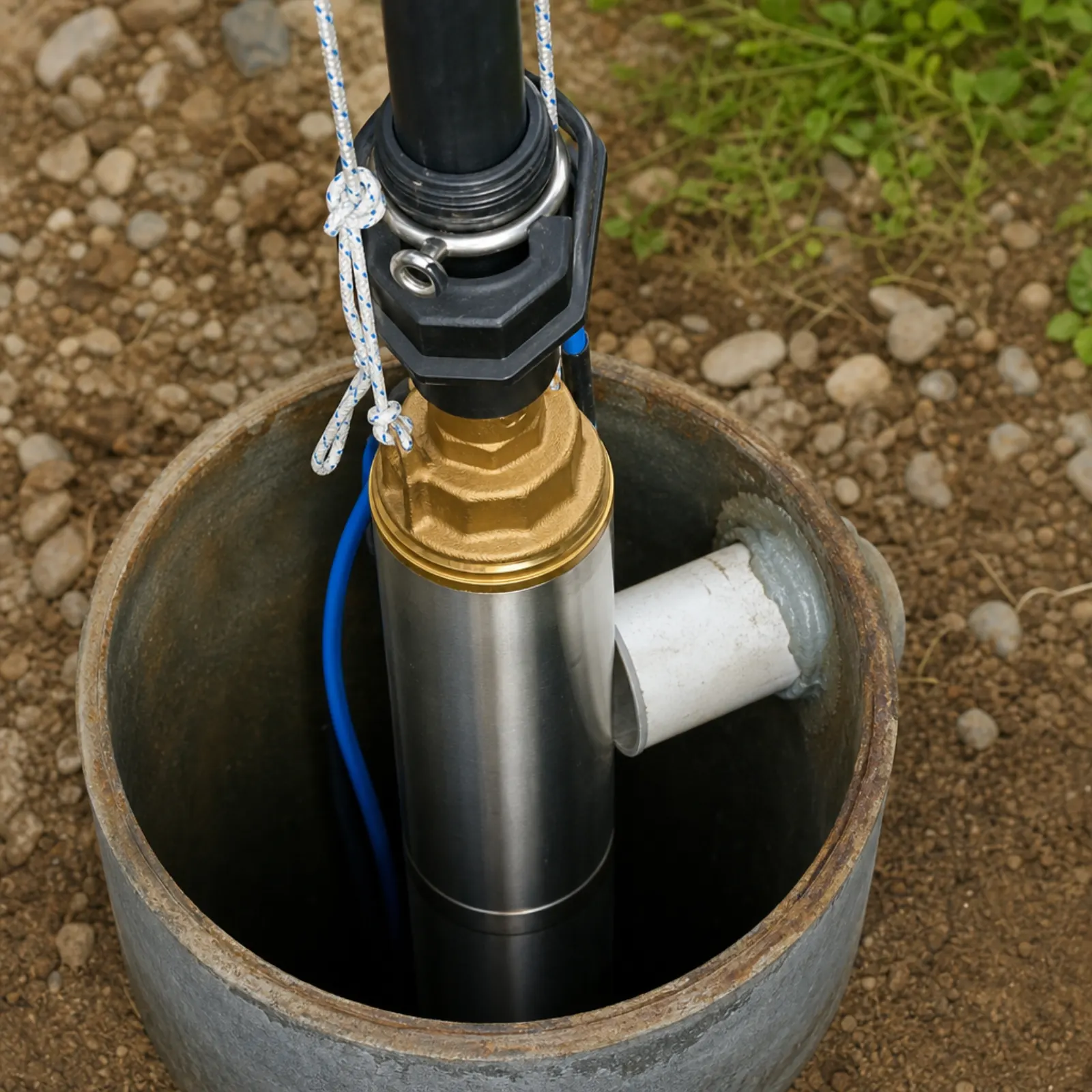
Well pump repair in Hendersonville starts with a $150 to $300 diagnostic visit that checks the breaker, pressure switch, control box, capacitor, pump amps, tank precharge, and check valve before anyone talks about pulling the pump. Most no-water and low-pressure calls in Henderson County end in a $150 to $450 repair of one of those parts. When the pump itself has failed, you get depth-based replacement pricing from $1,200, and you get it before the work starts.
What “the well quit” usually means
A private well is a chain of parts, and the pump at the bottom is the most expensive and the least likely to be the one that failed. The usual order of failure runs roughly like this:
- The breaker. A power blink, a lightning storm over Bearwallow, or a pump drawing a little high on a hot day trips the well breaker. Reset it once. If it trips again, stop: that is a short in the pump or the wire, and resetting it repeatedly will finish off whatever is left.
- The pressure switch. The small gray box on the tank tee with the contacts inside. Contacts pit and burn after thousands of cycles, and the little tube that feeds it plugs with iron sediment, which is common in mountain water. A stuck-open switch means no water; a stuck-closed switch means a pump that never shuts off. $150 to $350.
- The control box. Three-wire submersible pumps have a box on the wall holding a start capacitor and relay. Capacitors dry out and fail, and a hot well house in August or a cold one in January speeds it up. The pump hums and will not start, or starts and trips. $200 to $450.
- The check valve. Sticks open, the water column drains back down the well between cycles, and the pump short-cycles itself to death. $200 to $400.
- The drop pipe and wire. A split in the drop pipe or a chafed wire where the pump swung against the casing for fifteen years. Pressure drops, air spits from taps, or the breaker trips. $400 to $1,500 depending on depth.
- The pump. Worn impellers that cannot reach cut-off pressure, or a shorted motor. This is the one that gets the hoist. See pump replacement.
- The well. Water level below the intake in a low-yield well during a dry September, or, rarely, a well that has genuinely gone dry. This is a pump-setting, storage, or hydrofracturing conversation, not a pump sale.
Symptom by symptom
No water at all. Breaker, switch, capacitor, pump, drop pipe, or dry well, in roughly that order of likelihood. Emergency call; the no-water page has the fee and the two-minute check.
Low pressure or air from the taps. The tank bladder is the first suspect. Tap the tank: hollow at the top and solid at the bottom is normal, solid all the way up is waterlogged. Otherwise, the water level in the well has dropped below the pump intake, the pump intake screen has clogged with iron bacteria or sediment, or the drop pipe has a leak. The static and pumping water levels are worth measuring on low-pressure calls because a well that made 8 gallons a minute in 1998 may make 3 today, and the pump may simply be set too shallow for the current water level.
Short cycling. Pump on, off, on, off, every few seconds while a tap runs. Waterlogged tank or bad check valve, nearly always. This is the symptom that turns a $700 repair into a $3,000 pump if it runs for a season, because every start is the hardest thing a motor does. Fix it the week you notice it. Details on the tanks and switches page.
Pump runs and never shuts off. A leak somewhere between the pump and the switch (a split drop pipe, a burst line under the yard, a hydrant left open in a pasture), a failed check valve, a switch stuck closed, or a pump too worn to reach the cut-off pressure. If the gauge climbs to the cut-in pressure and hangs there, the pump is pushing but cannot get over the hump: worn impellers, or a well being pumped faster than it recovers.
Brown or cloudy water after rain. Surface water entering through a bad well cap, a cracked casing, or a casing that has been buried by landscaping. State rules require the casing to stand at least 12 inches above the ground for exactly this reason. Get the county’s $50 bacteria test, then fix the entry point. The water testing page covers it.
Stains and smells. Orange is iron, black is manganese, blue-green is copper being dissolved by acidic water, rotten egg is hydrogen sulfide. None of those is a pump problem; all of them are a water-chemistry problem common in the Blue Ridge granite and gneiss, and they get a test before a treatment quote.
Before you call, you can put a range on your own repair with the free well pump calculators, which run on the same published prices.
How a repair visit goes
- Phone triage. What the house is doing, when it started, any storm or outage, gauge reading. That lets us bring the likely parts.
- Power and controls. Voltage at the switch, voltage and capacitor test at the control box, contacts inspected.
- Pump electrical. Amp draw on each leg and insulation resistance on the leads. This one reading separates a healthy pump from a dying one without pulling anything.
- Tank and valve. Precharge checked with the system drained (it should sit 2 psi below the switch cut-in), bladder condition, check valve holding.
- Water level, if pressure is the complaint. Static level and drawdown under pumping, compared to the pump setting.
- The repair. Replaced with a like part, system disinfected if the well seal was opened (state rules require disinfection after pump work), pressure verified at the far tap.
Do not let anyone pull a pump to “have a look.” Pulling is the expensive part of pump work, and the meter and the gauge show whether it is necessary.
Why the rock matters to a repair
The U.S. Geological Survey’s Ground Water Atlas describes the aquifer under Henderson County as fractured crystalline bedrock (gneiss, schist, and granite) capped with weathered regolith, with an average reported yield of about 15 to 20 gallons per minute and fractures that thin out with depth. Two consequences for repair work. First, mountain wells are commonly low-yield, so a pump that cannot keep up in a dry spell may be fine; the well is the limit, and the fix is a lower pump setting, a smaller pump, or storage, not horsepower. Second, mountain water is acidic and often carries iron, which eats pressure switches, gums up intake screens, and shortens the life of everything metal. A switch that fails every three years in Dana is not bad luck; it is the water, and a sediment filter ahead of the switch tube is a cheap fix.
Where pump repair is covered
Hendersonville and the county: Flat Rock, Fletcher, Mills River, Etowah, Dana, Edneyville, Zirconia, Tuxedo, and Mountain Home, plus Brevard in Transylvania County and Columbus in Polk. Ask anyone, us included, for the North Carolina certification and proof of insurance, and the pricing page has every number in this trade. Tell us the symptom and the depth, and we will come back with a number and a visit.
Frequently Asked Questions
What does a well pump repair visit cost?
The diagnostic visit is $150 to $300, usually credited toward the repair by many crews. From there a pressure switch is $150 to $350, a control box or capacitor $200 to $450, a check valve $200 to $400, and a drop pipe or wire repair $400 to $1,500. If the pump itself is gone, the replacement page has depth-based pricing from $1,200.
How do you know whether it is the pump or something cheaper?
By testing, not guessing. A good tech checks voltage at the switch and control box, test the start capacitor, read amps on the pump leads, check the tank precharge, and look at the switch contacts. A pump drawing no amps with good voltage is dead or has a broken wire; a pump drawing high amps is locked or worn; a pump that runs fine with no pressure has a leak or a bad check valve. The meter tells which.
My pump runs but the pressure is weak and the taps spit air. What is that?
Either the water level in the well is dropping below the pump intake (a low-yield well in a dry spell, or a pump set too high), the pressure tank bladder has failed, or there is a hole in the drop pipe letting water fall back. Air in the lines points at the first or third. Check the tank first because it is cheapest, then measure the water level.
Can you repair a pump instead of replacing it?
The parts around the pump, yes: switches, boxes, capacitors, check valves, wire splices, and drop pipe are all repaired. The submersible motor and pump end themselves are sealed units, and once a motor has shorted or the impellers are worn there is no economical rebuild on a residential pump. You should know which one you have before anything is pulled.
Do you work on wells in Fletcher, Mills River, and Flat Rock?
Yes, and out to Etowah, Brevard, and Columbus. Fletcher is about nine miles north, Mills River eight miles up NC 191, Flat Rock four miles south, and Etowah eight miles west on US 64. Same-day for no-water calls anywhere in that footprint.
More wellpump services
Areas we serve
- Hendersonville, NC
- Well Pump Repair in Brevard, North Carolina
- Well Pump Repair in Columbus, North Carolina
- Well Pump Repair in Dana, North Carolina
- Well Pump Repair in Edneyville, North Carolina
- Well Pump Repair in Etowah, North Carolina
- Well Pump Repair in Flat Rock, North Carolina
- Well Pump Repair in Fletcher, North Carolina
- Well Pump Repair in Laurel Park, North Carolina
- Well Pump Repair in Mills River, North Carolina
- Well Pump Repair in Saluda, North Carolina
- Well Pump Repair in Zirconia, North Carolina